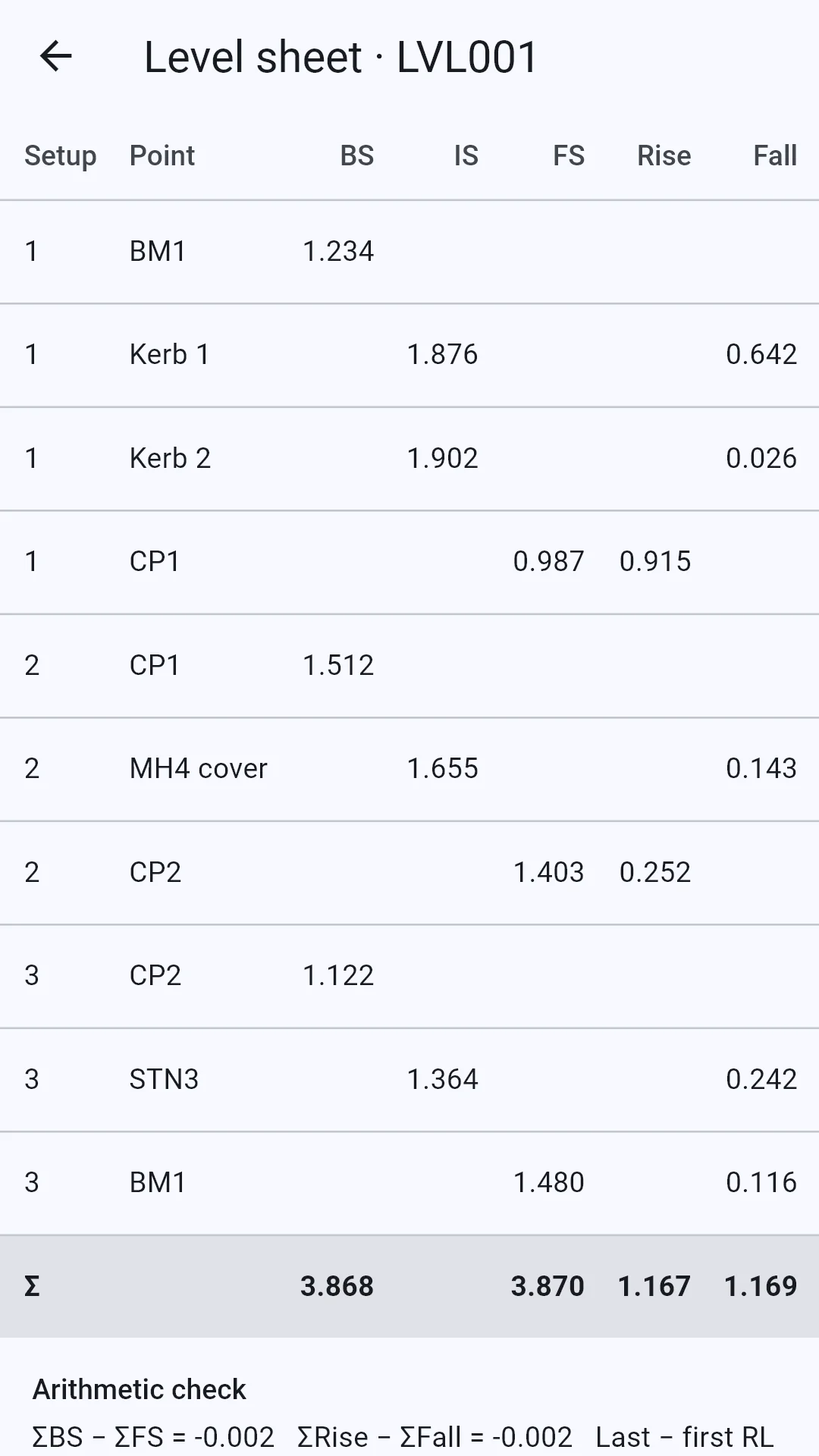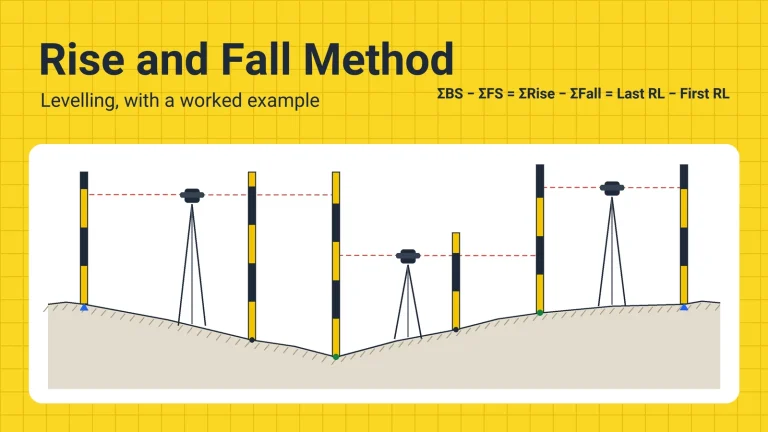
The rise and fall method is one of the two ways of reducing a level run by hand, and it’s the one most level books are printed for. If you’ve ever stared at a page of backsights and foresights wondering where the reduced levels come from, this is for you. I’ll go through a short run from start to finish, with the checks that tell you the arithmetic is right.
If you need a refresher on the book itself, I’ve written about levelling field books before.
The readings: BS, IS and FS
At every setup of the level you book three kinds of staff reading:
- Backsight (BS): the first reading after setting up, on a point of known level (a benchmark, or the change point you’ve just come from).
- Intermediate sight (IS): any reading between the backsight and the foresight, on a point you want the level of.
- Foresight (FS): the last reading before you move the level. It’s taken on a change point (CP), which becomes the backsight of the next setup, or on the benchmark you close on.
A change point has two readings, a foresight from one setup and a backsight from the next, and they’re booked on the same line of the level book.
How rise and fall works
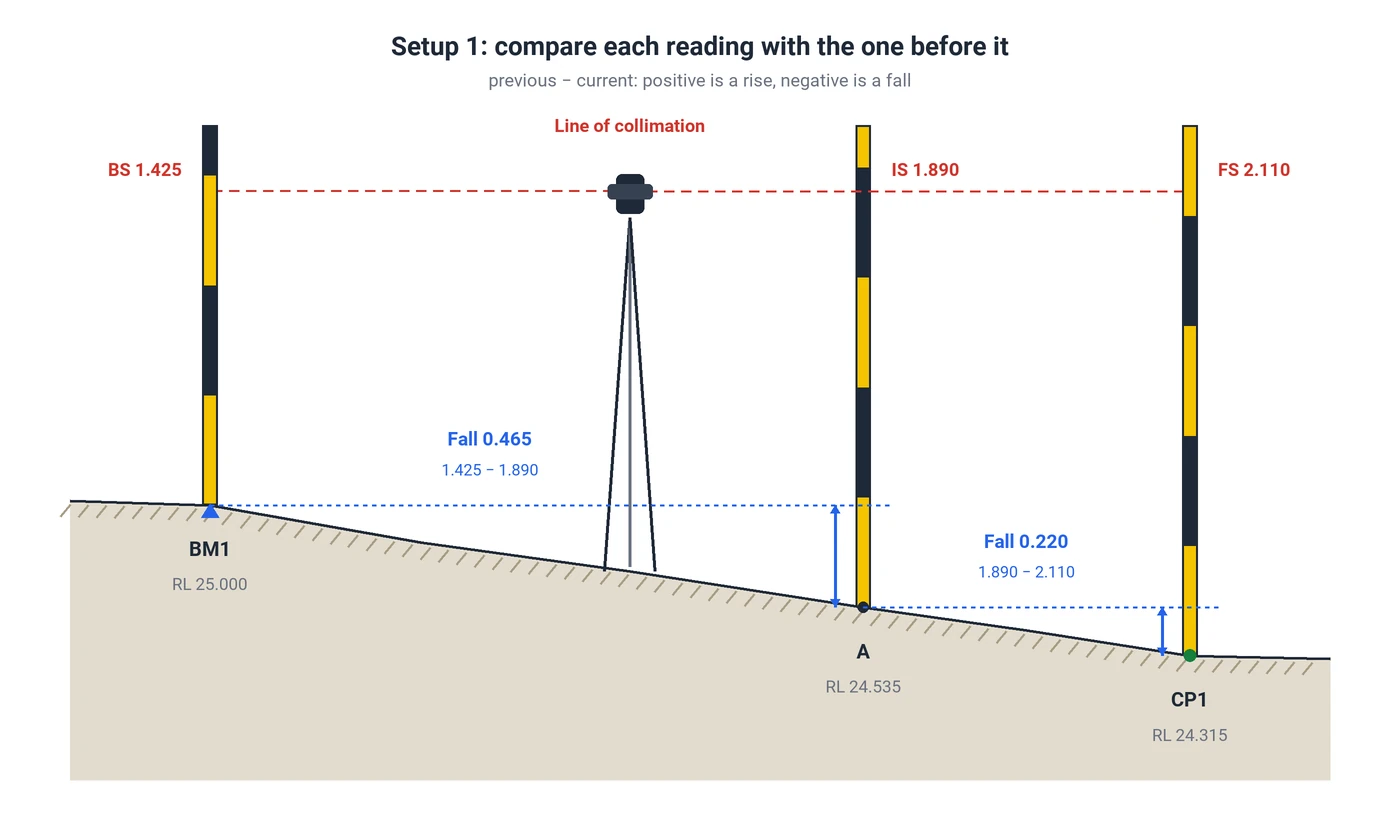
Within one setup, compare each reading with the reading before it. A smaller staff reading means the ground is higher, so:
- previous reading − current reading is positive: that’s a rise.
- It’s negative: that’s a fall (booked without the minus sign, in the fall column).
The reduced level (RL) of each point is the RL of the point before it, plus the rise or minus the fall. When you move the level, the comparison starts again from the new backsight: you never compare a reading with one from a different setup.
Worked example
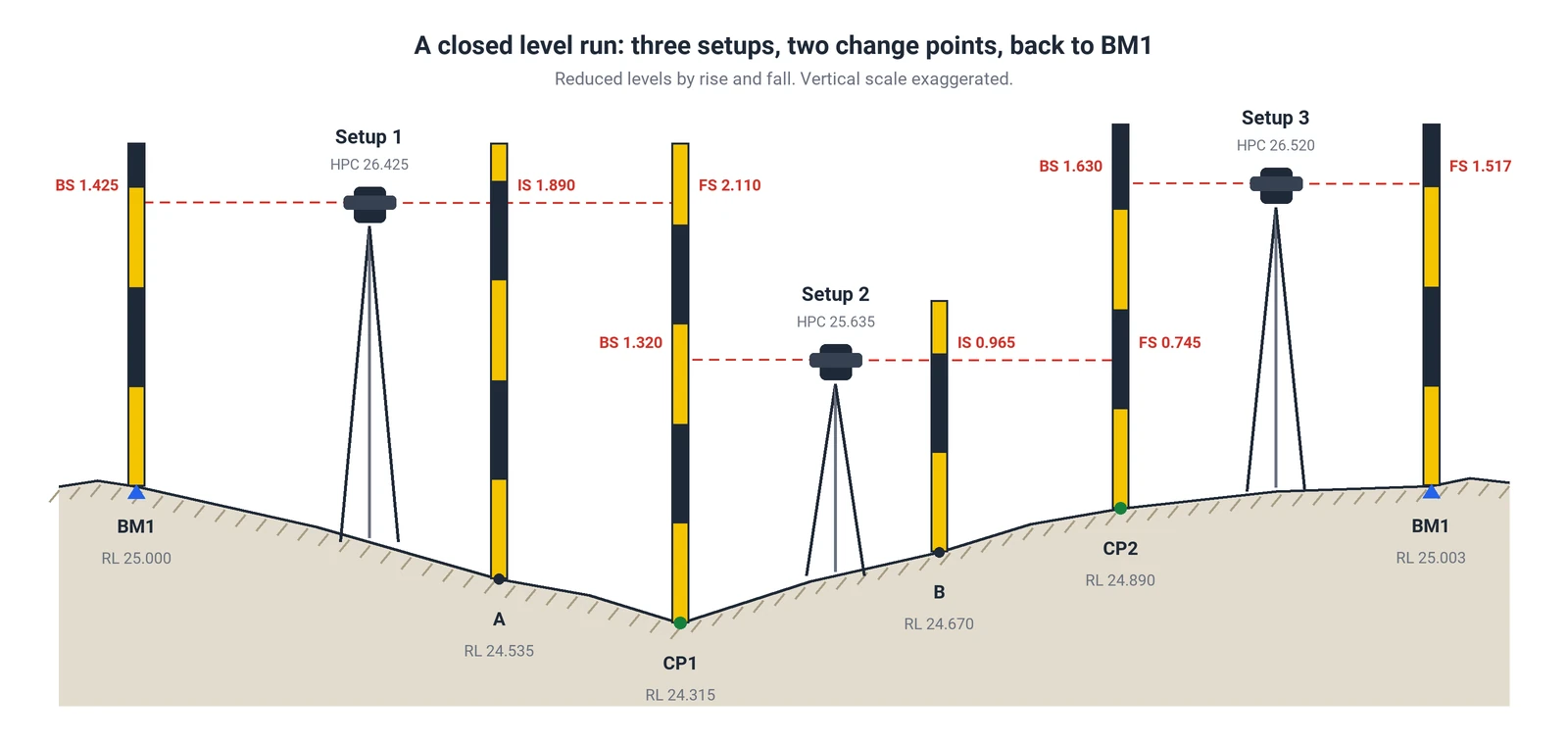
Here’s a short closed run: start on a benchmark BM1 with a known level of 25.000 m, level two points A and B on the way round, and close back on BM1. Three setups, two change points (CP1 and CP2). All readings are in metres.
| Point | BS | IS | FS | Rise | Fall | RL | Remarks |
|---|---|---|---|---|---|---|---|
| BM1 | 1.425 | 25.000 | Benchmark, known level | ||||
| A | 1.890 | 0.465 | 24.535 | Kerb | |||
| CP1 | 1.320 | 2.110 | 0.220 | 24.315 | Change point | ||
| B | 0.965 | 0.355 | 24.670 | Manhole cover | |||
| CP2 | 1.630 | 0.745 | 0.220 | 24.890 | Change point | ||
| BM1 | 1.517 | 0.113 | 25.003 | Close on benchmark | |||
| Sums | 4.375 | 4.372 | 0.688 | 0.685 |
Line by line:
- Setup 1. BS on BM1 is 1.425. The IS on A is 1.890: 1.425 − 1.890 = −0.465, a fall of 0.465, so A is 25.000 − 0.465 = 24.535. The FS on CP1 is 2.110: 1.890 − 2.110 = −0.220, a fall of 0.220, so CP1 is 24.315.
- Setup 2. Start again from the BS on CP1, 1.320. B reads 0.965: 1.320 − 0.965 = +0.355, a rise, so B is 24.670. CP2 reads 0.745: 0.965 − 0.745 = +0.220, so CP2 is 24.890.
- Setup 3. BS on CP2 is 1.630, FS on BM1 is 1.517: 1.630 − 1.517 = +0.113, so the run closes on BM1 at 25.003.
The arithmetic check
Before you look at the misclosure, check your sums. Three numbers must be equal:
ΣBS − ΣFS = ΣRise − ΣFall = last RL − first RL
In the example: 4.375 − 4.372 = 0.003, 0.688 − 0.685 = 0.003, and 25.003 − 25.000 = 0.003. All three agree, so the reduction has no arithmetic mistake. If they don’t agree, the error is in the sums or the reduction, not in the field, and it’s worth finding before anything else.
Note what the check doesn’t tell you: it proves the arithmetic, not the readings. A misread staff will pass the arithmetic check perfectly. That’s what closing the run is for.
Misclosure and the allowable error
We started on BM1 at 25.000 and came back to it at 25.003, so the misclosure is +3 mm.
Whether that’s acceptable depends on your specification. A common form is ± k·√n, where n is the number of setups and k is set by the job (some specifications use the length of the run in kilometres instead of n). With k = 5 mm and three setups, the allowable misclosure is 5 × √3 ≈ ±8.7 mm, so 3 mm is fine. If it’s outside the tolerance, the answer is to go back and level it again, not to adjust it.
Distributing the misclosure
A run within tolerance can be adjusted by sharing the misclosure out between the setups, on the assumption that each setup added a similar amount of error. Here the correction is −3 mm over three setups, so −1 mm per setup, accumulating as you go:
| Point | Setup | RL | Correction | Corrected RL |
|---|---|---|---|---|
| BM1 | – | 25.000 | 0 | 25.000 |
| A | 1 | 24.535 | −0.001 | 24.534 |
| CP1 | 1 | 24.315 | −0.001 | 24.314 |
| B | 2 | 24.670 | −0.002 | 24.668 |
| CP2 | 2 | 24.890 | −0.002 | 24.888 |
| BM1 | 3 | 25.003 | −0.003 | 25.000 |
The corrected levels go alongside the reduced ones. The readings themselves are never changed: they’re what you saw through the level, and they’re the record.
Rise and fall or height of collimation?
The other method, height of collimation (HPC, or HI), works out the level of the line of sight at each setup (HPC = RL + BS) and takes each reading off it (RL = HPC − reading). The same run gives HPCs of 26.425, 25.635 and 26.520, and exactly the same reduced levels.
Collimation is quicker when there are lots of intermediate sights, which is why it’s popular for setting out and for levelling a grid of spot heights. But its simple check (ΣBS − ΣFS = last RL − first RL) never touches the intermediate sights, so a mistake in reducing one of them goes straight through. Rise and fall checks every reduced level, intermediates included. It’s a little more work, and the reason I’d always reduce a run that matters by rise and fall.
Tips for a clean level run
- Keep backsight and foresight lengths about equal at each setup. Any collimation error in the level then cancels out. Check the level with a two-peg test before a job that matters.
- Use firm change points: a change plate, a kerb or a nail, never soft ground. The staff must sit at exactly the same height for the foresight and the next backsight.
- Always close the run, back on the starting benchmark or on a second one. An open run has no check on the readings at all.
- Book readings as you read them and never rub one out. If a reading is wrong, strike it through so it stays legible and book the new one beside it.
- Do the arithmetic check on site if you can. Finding a mistake before you pack up is a lot cheaper than finding it in the office.
Doing it on your phone
Rise and fall by hand is worth knowing, but you don’t have to do the sums on site any more. These days I book my levels in Surveyor’s Fieldbook, a free Android app that works like a level book: you book BS, IS and FS as you read them, and it reduces the run by rise and fall on screen, with the arithmetic check and the misclosure against your ± k·√n tolerance. Corrected levels only appear if you apply the misclosure, and the readings stay exactly as booked. More on that in digital field books.